
Emergency Garage Door Repair Near Me: What Cape Coral Homeowners Should Do First
When a torsion spring snaps, the sound is unmistakable: a hard bang that many homeowners describe as sounding like a gunshot in the garage. The instinct that follows is almost always the same, and almost always wrong: grab the emergency release cord and try to lift the door by hand. A broken torsion spring leaves the door unbalanced and extraordinarily heavy, and forcing it can turn a repair into a full replacement. If you’d rather not risk it, call (877) 792-6011. We answer 24/7.
Here’s the short version of what to do first: stop, don’t touch anything under tension, look for three specific visual cues to determine whether your door has failed safely, and then call a repair service with enough information that they arrive with the right parts. It’s a five-minute sequence that can save you hundreds or more. We walk through it below.
Step 1: Determine Whether Your Door Failed Safe or Failed Unsafe
Before you touch anything, take two minutes and look. A garage door failure is either safe-fail – the door stays where it is, nothing is under active load, and you can safely walk away and call for help – or unsafe-fail, meaning something is still under tension or moving. Knowing which one you’re looking at dictates everything that follows.
Here’s what to check in Cape Coral, in order:
- Spring tension. Look at the torsion spring mounted on the shaft above the door, or the extension springs running alongside the tracks. A snapped torsion spring usually shows an obvious gap where the coil has separated. A spring that’s still wound is still loaded, even if the door won’t move. Never touch a spring that looks intact but strained – that’s an unsafe-fail.
- Cable slack. Cables run from the springs to the bottom corners of the door. Puddle of slack cable on the floor or hanging loose along one side means the cable has come off its drum. That’s an unsafe-fail. A loose cable under load can whip across the garage with serious force.
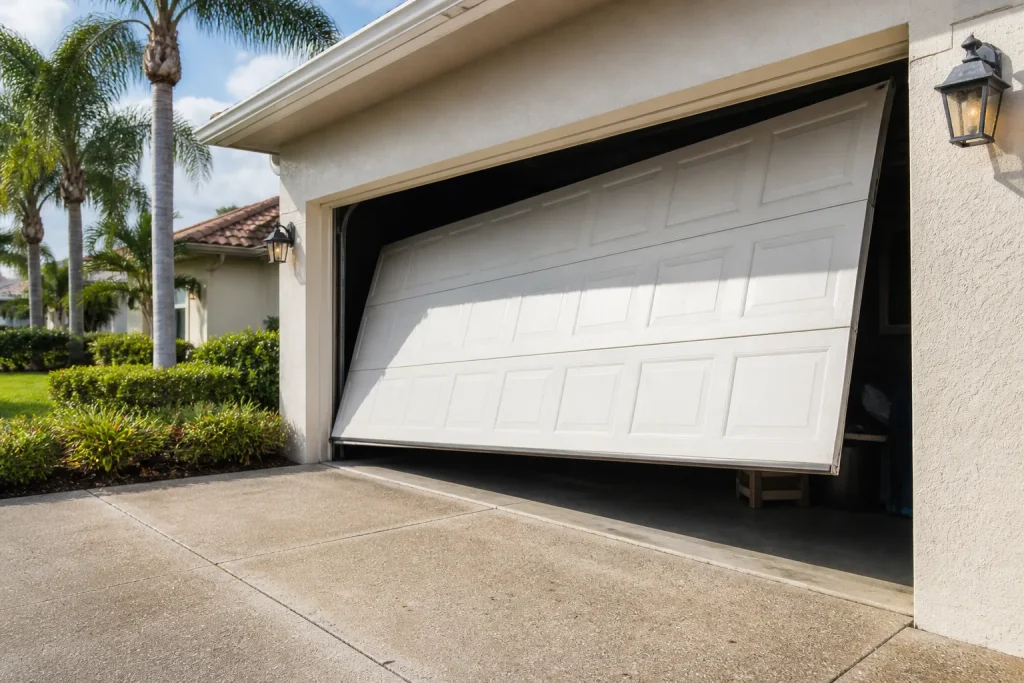
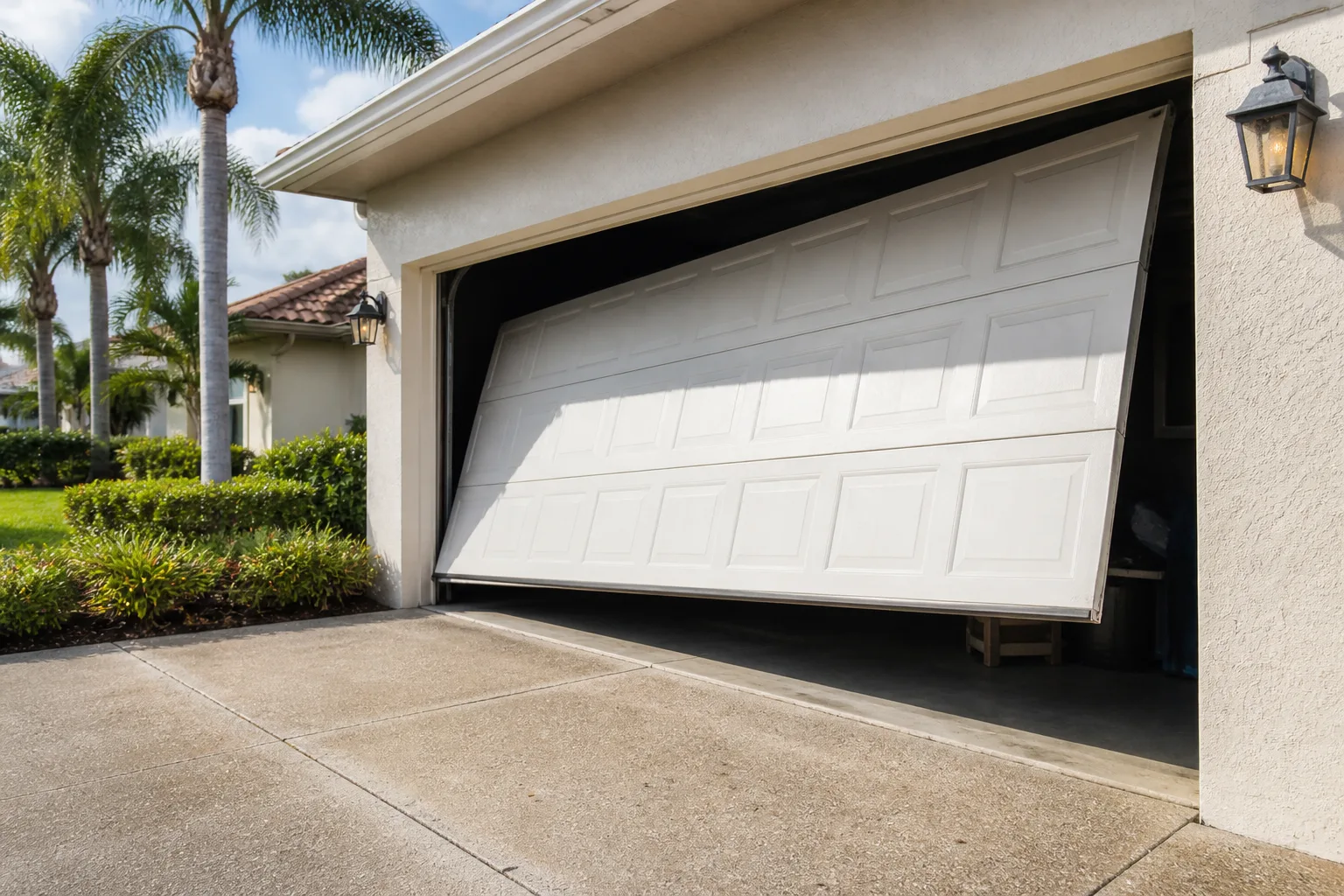
- Track damage. Look at the vertical and horizontal tracks for bends, separation at the joints, or a gap where the roller has jumped free. A door that’s off-track but still partially supported is an unsafe-fail; a door sitting flat in its tracks is generally safe-fail.
If you see any of the unsafe signs, don’t operate the opener and don’t try to move the door. Call a professional. The garage door is one of the few systems in a home where the springs and cables hold enough stored energy to cause real injury, and knowing that is the most useful thing you can do in the first five minutes.
The Emergency Release Cord: When It Helps and When It Hurts
The emergency release cord is the red handle hanging from the opener rail. It’s designed to disconnect the door from the opener so it can be operated by hand during a power outage. It is not a fix, and pulling it can make a bad situation significantly worse.
There’s exactly one scenario where pulling that cord is the right move: the opener is running, the motor is engaged, and there’s no visible spring, cable or track damage. In that case, the release disconnects a struggling opener from a door that can still be operated by hand, and you can lower it safely. That’s the rare clean case.
The two situations where pulling the release makes things worse:
- Broken torsion spring. The door is now unbalanced and dead-heavy. Pulling the release means the full weight drops onto you with no opener assist. That’s how people get hurt.
- Cable off the drum or door off-track. The door is no longer traveling on its intended path. Release it and it can drop or bind unpredictably onto whatever is in the garage, including a car.
If you’re not sure which situation you’re in, treat it as unsafe and leave the door alone. We’ve seen plenty of Cape Coral garages where a homeowner’s attempt to “just get the door down” turned an $1,200-ish repair into a full replacement because the door got bent on the way down. Leave it closed. Call the pros.
Why Cape Coral Humidity Changes the Emergency Response Timeline
Garage doors in Cape Coral live in a different environment than doors in the middle of the state. The humidity here is high and consistent much of the year, and that accelerates rust on torsion springs, cables and hinges more than a dry-inland climate would. A spring that’s starting to corrode doesn’t fail on a schedule – it usually fails without warning – but the rust is what makes failure more likely in the first place.
What does that mean for emergency response? Two things:
- Don’t wait on a corroding spring. If you can see visible rust on the coils or heavy rust at the cable ends, that door is a candidate for failure. Have it inspected before it goes. A preventive spring replacement is always cheaper than an emergency repair plus collateral damage.
- Expect same-day repairs, not same-day installation. Repair work – springs, cables, openers, panels – can often be handled same day. Full door replacement involves measurement and ordering, so it’s scheduled. If the door is a total loss, know that the replacement itself won’t happen the same day; the goal of the emergency visit becomes making the garage secure.
Humidity also affects the opener itself. If you’ve got a LiftMaster or Chamberlain unit, the photo-eye sensors can fog or collect moisture and cause false obstructions. That’s a different failure mode than a snapped spring, and a specialist who knows those systems can usually diagnose it quickly over the phone or on-site.
What to Tell the Repair Company When You Call
The single best thing you can do to get the right fix the first time is to give the repair company good information on the phone. That’s how you avoid a second visit for a special-order part, and it’s how you avoid a company showing up with the wrong spring or the wrong opener. Have these ready:
- The brand of the door and opener. If you know it’s a Raynor, a Craftsman, a Clopay, or a LiftMaster, say so. Brand-matched diagnosis saves time. If you don’t know, look at the opener housing or the sticker on the inside of the door panel – most brands are labeled.
- The failure mode you observed. “I saw a gap in the torsion spring” or “the cable is hanging loose on the left side” tells the technician far more than “it won’t open.”
- The door’s approximate size. Single-car or double-car gives the technician a starting point for spring sizing. If you can’t measure, that’s fine – they’ll measure on-site.
- Whether the door is safe-fail or unsafe-fail. If unsafe, say so. That changes how the visit is approached.
- Your address and gate or access notes. Small thing, saves minutes.
If you can provide all of that, the odds of a one-visit fix go way up. If you can’t, don’t sweat it. Call (877) 792-6011, and we’ll walk through the questions with you. We answer 24/7 and dispatch fast from 7am to 7pm, Sunday through Friday.
How to Secure the Garage Overnight if Same-Day Repair Isn’t Possible
Most emergency guides stop at “call a pro.” But what if the repair can’t happen today? You still need to sleep tonight with the garage reasonably secure and the door not actively trying to fall.
Here’s the safe approach:
- Leave the door in its current position if it’s closed and stable. A door that’s sitting flat and closed in its tracks is already secure. Don’t try to improve it.
- If the door is partially open and unsafe, do not force it. Instead, secure the opening from the inside with a physical bar or a piece of lumber cut to fit across the tracks, and keep the opener disconnected so nothing tries to move the door overnight.
- Lock the man-door if you have one and add a secondary lock or latch on the garage side of the main door if the door is stuck open. The goal is to make the opening difficult to enter, not to make the door operational.
- Never prop, wedge or zip-tie a torsion spring or cable. Any method that puts a person near a loaded spring is out of bounds.
Then get on the schedule for the next available visit. A call outside dispatch hours is booked into the next opening, Sunday through Friday, 7am to 7pm. If you’re a landlord or property manager handling a multi-unit issue, this is the moment to get the address list and unit numbers together so a single dispatch can handle them efficiently.
When to Call a Pro (and What to Expect When You Do)
If you’re in Cape Coral and you’re dealing with a snapped spring, a cable off the drum, a door off its tracks, or an opener that’s grinding or dead, that’s a call-a-pro situation. Springs and cables are the highest-risk part of any garage door system, and a proper repair means matching the spring to the door’s weight, resetting tension safely and testing the balance before anyone goes near it with an opener.
When you call, ask about a free estimate and confirm the price is agreed before any work starts. The written estimate is what sets the final price; a good company will give you the number in writing before anyone touches the door. Ask whether the technician works on your brand. We service LiftMaster, Chamberlain, Genie, Clopay, Amarr, Wayne Dalton, Craftsman and Raynor, so whether your system is a modern smart opener or an older unit, the diagnosis starts from the same place.
There’s no need to call a second company for a different brand, and there’s no need to worry that a minor fix will get talked up into a replacement. Our technicians have up to 15 years of experience, and the goal of every visit is the right fix, not the biggest one.
Related services in Cape Coral: you can read more about garage door repair or, if the opener is the problem, garage door opener repair. For a door that’s beyond repair, see garage door installation.
The Bottom Line
The first five minutes after a garage door failure are the ones that matter most. Look before you touch. Determine whether the door is safe-fail or unsafe-fail. Don’t pull the release cord unless nothing is broken and the opener is the only issue. Call a repair company with brand, failure mode and door size, and secure the garage safely if the fix has to wait until the next opening.
If you’re in Cape Coral and need help, Cape Coral Garage Door Repair Pros offers free estimates. Call (877) 792-6011. We answer 24/7, and fast dispatch runs from 7am to 7pm, Sunday through Friday.
You can also start with our main page for Cape Coral Garage Door Repair Pros.
Frequently Asked Questions
No. A broken torsion spring leaves the door unbalanced and much heavier than it looks, and forcing it can drop the full weight on you or bend the door. Leave it closed and call a professional. If you’re in Cape Coral and need help, call (877) 792-6011 for a free estimate.
Look at the spring for a gap, the cables for slack or a puddle on the floor, and the tracks for bends or a roller that’s jumped. Any spring still wound, any slack cable, or any bent track is unsafe-fail. A door sitting flat in its tracks has failed safe. When in doubt, treat it as unsafe and call us at (877) 792-6011.
Pricing is set per job by the written estimate, and the estimate is free. Call (877) 792-6011 and we’ll give you the number in writing before any work starts.
Don’t force a loaded spring or a slack cable. Secure the opening from the inside with a physical bar across the tracks, connect nothing to the opener, and lock the man-door if you have one. Then book the next opening, Sunday through Friday, 7am to 7pm. Call (877) 792-6011 to get on the schedule.
Written by the team at Cape Coral Garage Door Repair Pros.
Need Garage Door Help?
Call Cape Coral Garage Door Repair Pros - the local pro we connect you with is licensed and insured, here with fast help in Cape Coral.
(877) 792-6011