
Top Signs You Need Garage Door Service – Don’t Ignore These
Most garage door symptom guides flatten every problem into one category, and that’s where homeowners get misled. A door that reverses before it touches the ground almost always has a sensor problem. A door that reverses right after it touches the ground usually has a travel-limit or down-force problem. Same complaint, two completely different subsystems, two very different repair bills. This blog is about diagnostic literacy: tracing what your door is doing to the part that’s actually failing, so you can describe the problem accurately and understand exactly what you’re being quoted for.
If you’d rather not spend your Sunday deciphering a limit switch, call us at (877) 792-6011. Free estimates, upfront pricing, and we work on your brand.
- Key takeaway: Match the symptom to the subsystem before you accept any diagnosis.
- Key takeaway: Springs, openers, tracks, and sensors each fail in distinct, recognizable ways.
- Key takeaway: Cape Coral’s humidity and standing water after heavy rain shorten maintenance intervals here versus inland guides.
- Key takeaway: A 60-second balance test tells you more about spring wear than any visual inspection.
What do the warning signs of garage door problems actually mean?
They mean one of four subsystems is failing: springs and cables, the opener, the track and hardware, or the safety sensors. That’s the whole system. When we diagnose a door, we’re assigning the symptom to one of those four buckets. That’s the same mental model you can use before you call anyone, and it’s how you can spot a lazy or wrong diagnosis in the first five minutes. Our technicians bring up to 15 years of experience to this, and across garage door repair calls the mapping game rarely changes. Learn the map and you’ll save yourself from replacing a door that just needed a $10 sensor bracket. Here’s the mapping, symptom by symptom:
- Springs: Door feels dead heavy when you lift it by hand, opens a few feet then stops, or you heard a single loud bang from the garage. A torsion spring that snaps usually takes the door’s balance with it.
- Opener: Motor runs but the door doesn’t move, the door moves but the motor strains, or the unit hums and stops. That’s a drive-train problem inside the opener, not a spring problem.
- Track and hardware: Door binds partway, screeches, or swings crooked with one side lagging. Bent track, worn rollers, or a loose hinge.
- Sensors: The door closes partway and reverses on its own, or won’t budge from the open position. Something’s blocking the beam or one photo-eye is misaligned.
One symptom, one subsystem. When a company tells you “you need a new door” for a reversing issue, ask what part failed. If they can’t tell you, get another opinion.
How do spring problems look different from opener problems?
Spring problems live in the door, opener problems live in the motor, and the giveaway is whether the door moves smoothly but slowly, or doesn’t move at all. Springs are the counterbalance. When they’re worn, the door gets heavy and the opener has to work overtime to fight it. Cables, torsion bars, and extension springs are all under extreme tension and are genuinely dangerous to touch. This is the part where we stop and say it plainly: spring repair is not a DIY job, and it’s the most commonly botched repair in this trade. If you suspect a broken spring, don’t pull the manual release and don’t stand under the door. Call a trained professional. Openers are different. A LiftMaster or Chamberlain with a dead motor or a stripped gear runs but doesn’t move anything. That’s a motor-side failure, and if you’ve got a smart-home opener, we can usually repair the unit rather than replace it, because we work on your brand. The two repairs use different parts, different tools, and different skill sets. Knowing which one you have keeps a spring quote from turning into an opener replacement.
Why does slow wall-button response point to a different failure than slow remote response?
Because the wall button and the remote travel two different signal paths, and each path fails for its own reasons. The wall button is hardwired to the opener or communicates over the internal logic board. The remote sends radio frequency, and it has to be picked up by the opener’s antenna. So slow response from one and not the other isn’t random. It’s a map your technician reads. A wall button that takes a second or two to register, or needs a hard press, usually points to a failing logic board contact or a wall-station issue. That’s opener-side. A remote that works up close but not from the driveway is usually a battery, a damaged remote, or RF interference from a neighbor’s opener. That’s a signal-side issue. This distinction matters for repair cost. A remote problem might be a $10 fix. A logic board issue is a component repair. When you call, tell us which control surfaces are slow. “Slow from the wall button, fast from the car remote” is a diagnostic clue we can act on before we arrive. It’s also how garage door opener repair gets scoped properly instead of by guesswork.
What Cape Coral-specific warning signs do inland guides miss?
Cape Coral’s humidity and rain patterns wear doors differently than a dry-climate checklist admits. In our experience, the two most common local symptoms inland guides never mention are oxidation on the torsion hardware and a failing bottom seal. Here’s what to look for:
- Chalky white or powdery residue on torsion springs and hardware. That’s oxidation. The humidity here keeps oxidizers busy, and hardware that would last years in a dry climate ages faster. Oxidation itself isn’t a failure, but it’s a flag that the springs and plates deserve a closer look before a part seizes or a bearing goes dry.
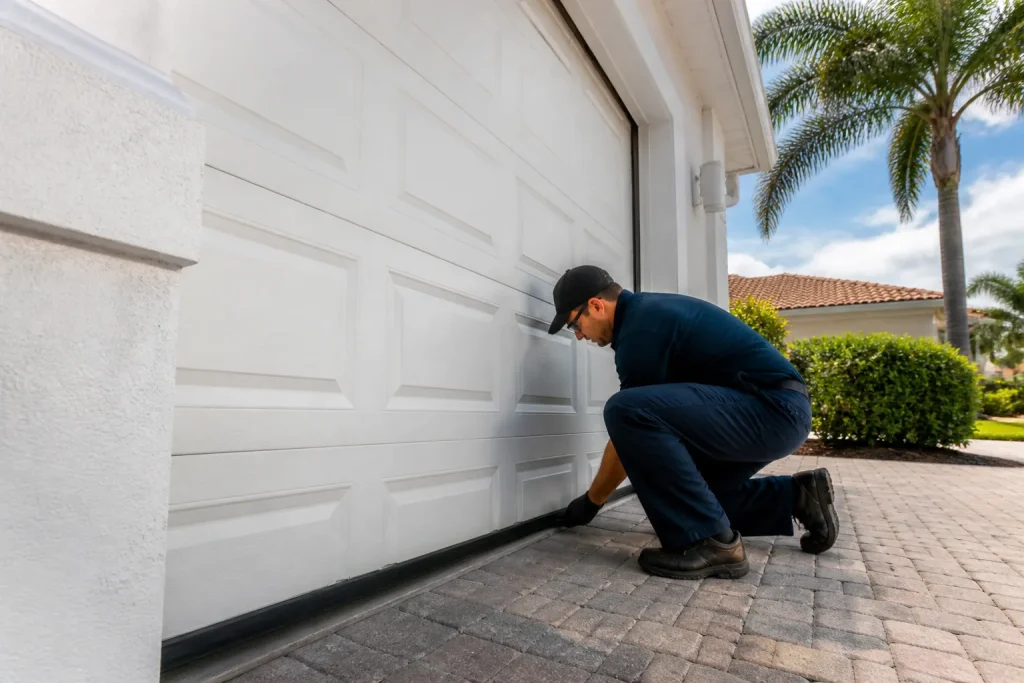
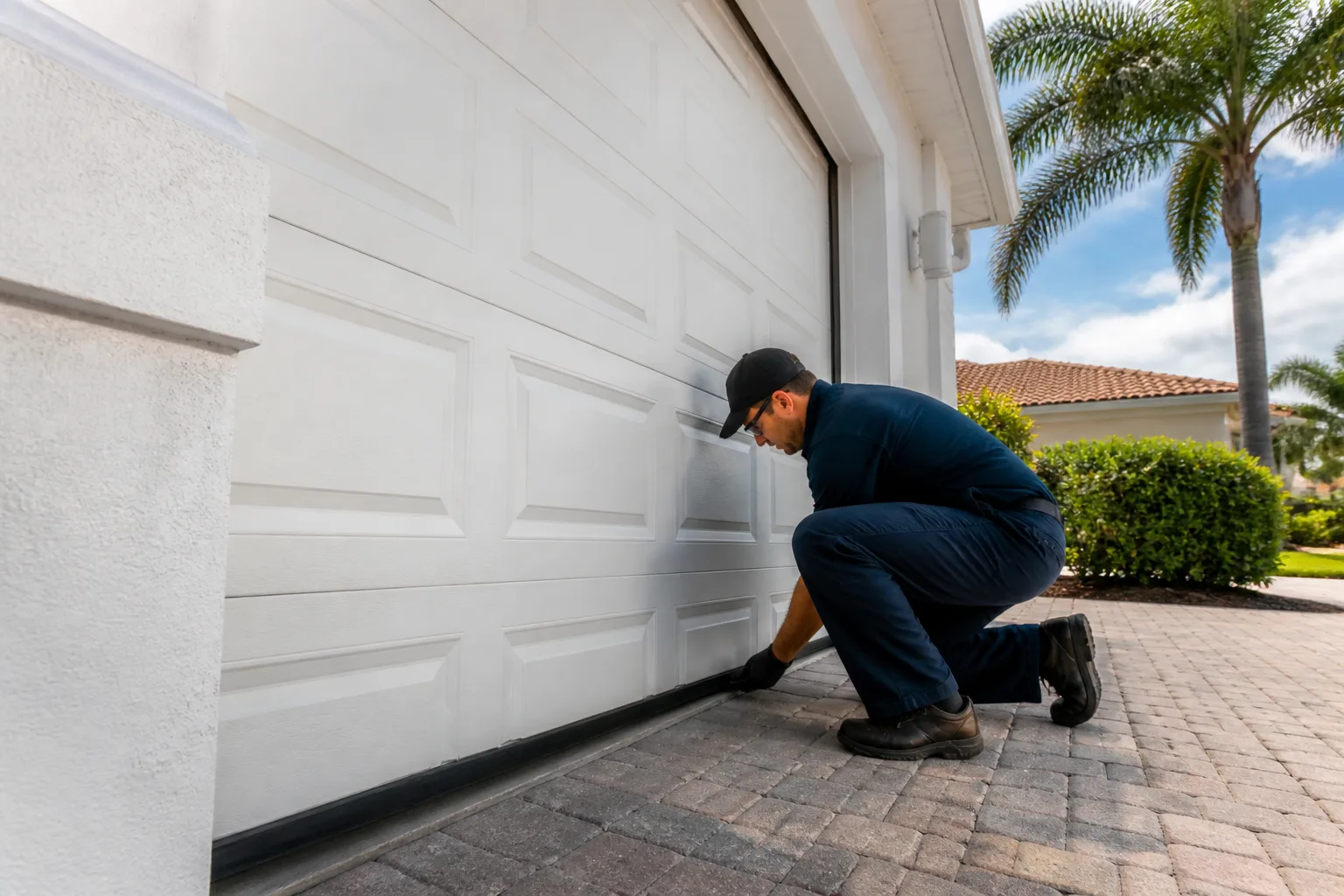
- Bottom seal splitting, curling, or pulling away. Wood composite and rubber bottom seals absorb water from standing moisture after heavy rain events, and they fail from the bottom up. A worn seal lets water, debris, and small pests under the door and then works its way into the bottom panel. A Wayne Dalton or Clopay panel replacement costs a lot more than a seal.
- Brittle, cracking rollers and hinges. Same humidity story. Worn rollers come apart quietly, and then one day the door binds hard on a track.
None of these show up on a thermal-imaging-style checklist you’d read for a dry state. They’re the local pattern. Replacing a service on a schedule after a Florida summer is how you catch them before they become a safety issue.
What’s the 60-second manual balance test?
It’s a fast, safe check that reveals spring wear before a broken spring turns into an emergency, and it’s the single most useful thing you can do in your garage. Do it standing clear of the springs, and do it with the door closed.
- Pull the manual release handle to disconnect the opener. The door should now be in manual mode.
- Lift the door by hand to halfway. If you have to strain, the springs are weak. Stop there and call.
- Let go at halfway. A balanced door holds its position by itself. A door that creeps up means the springs are over-tensioned. A door that drops means they’re worn.
- Lower it slowly and re-engage the opener. If it behaves like a lead weight the whole way, the springs are done.
A healthy door balances like a seesaw. A worn one feels like a refrigerator. That test tells you more about spring condition than anything visual, and it costs you a minute. It also tells you whether a “tune-up” quote is really a spring replacement quote in disguise. If the balance test worries you and the door is in Cape Coral, that’s a good moment to pick up the phone.
Standing water, seals, and the tune-up interval that’s too short here
The standard 12-month tune-up recommendation is calibrated for dry climates, and it falls short in Cape Coral. Between the humidity aging hardware and standing water after summer rain stressing the seals, we don’t think a once-a-year schedule matches the wear here. A twice-yearly check, timed to the wet and dry seasons, catches oxidation and seal failure before they become panel replacement. Combine that with the balance test and you’ve got a maintenance rhythm the dry-climate checklists miss. Full door installations in Cape Coral work the same way; we size and measure for the local conditions so the door and hardware are matched to the house, not to a catalog spec. If you’re thinking about a replacement rather than a repair, garage door installation is where that starts, and it’s measured and scheduled, not rushed.
When should you call a pro?
Call a pro the moment the symptom points to springs or cables, and call us the moment you’re unsure which subsystem you’re looking at. Springs are the dangerous part. A door that feels heavy, a snapping sound from the springs, or a door stuck open are all signs to stop and get a trained technician. For everything else, a balance test, a visual check of the seal and rollers, and an accurate description of the symptom is enough to make the call. We work on your brand across Clopay, Amarr, Wayne Dalton, and Craftsman, along with LiftMaster, Chamberlain, Genie, and Raynor, so the diagnosis doesn’t stall on a brand-specific guess.
Related services in Cape Coral: Cape Coral Garage Door Repair Pros covers the full range, and one call covers it from parts to installation. We answer 24/7. Fast dispatch, 7am-7pm, Sunday through Friday.
The Bottom Line
Learn the map: springs, opener, track, sensors. Match the symptom to the subsystem before you accept a diagnosis. Do the 60-second balance test. Watch for Cape Coral’s local wear pattern (oxidation, bottom seals, brittle rollers) and don’t trust a 12-month tune-up to catch it. If you’re in Cape Coral and need help, Cape Coral Garage Door Repair Pros offers free estimates, and the price is quoted and agreed before any work starts. Call (877) 792-6011. We answer 24/7. Fast dispatch from 7am to 7pm, Sunday through Friday.
Frequently Asked Questions
It’s almost always a sensor problem. The safety beam is being blocked or one photo-eye is misaligned, and the opener reads that as an obstacle. A spring problem makes the door heavy or causes it to stop or drop, not reverse before contact. Check for an obstruction in the beam path and look at both sensor lights before you call. If the lights are a solid color and the door still reverses, call (877) 792-6011 for an exact quote.
Yes. The manual balance test does it: release the opener, lift the door to halfway, and let go. A balanced door holds; one that drops or creeps up has worn or over-tensioned springs. We read the same test and won’t touch the springs to make the call. If the test looks bad, call (877) 792-6011 and we’ll get a technician out. We don’t recommend adjusting or replacing springs yourself.
Because they take different signal paths. The wall button is wired to the opener, so a slow or needing-a-hard-press response points to a logic board or wall-station issue. The remote uses RF, so an issue there points to a battery, the remote itself, or interference. Tell us which control is slow when you call (877) 792-6011, and we’ll scope the repair accurately.
More often than the standard 12-month interval. Humidity accelerates oxidation on torsion hardware, and standing water after rain wears the bottom seal faster than in dry climates. We suggest a check timed twice a year, once around each season change, plus the balance test when the door starts to feel heavy. Call (877) 792-6011 for a free estimate, and we’ll tell you what your door actually needs.
Written by the team at Cape Coral Garage Door Repair Pros.
Need Garage Door Help?
Call Cape Coral Garage Door Repair Pros - the local pro we connect you with is licensed and insured, here with fast help in Cape Coral.
(877) 792-6011